
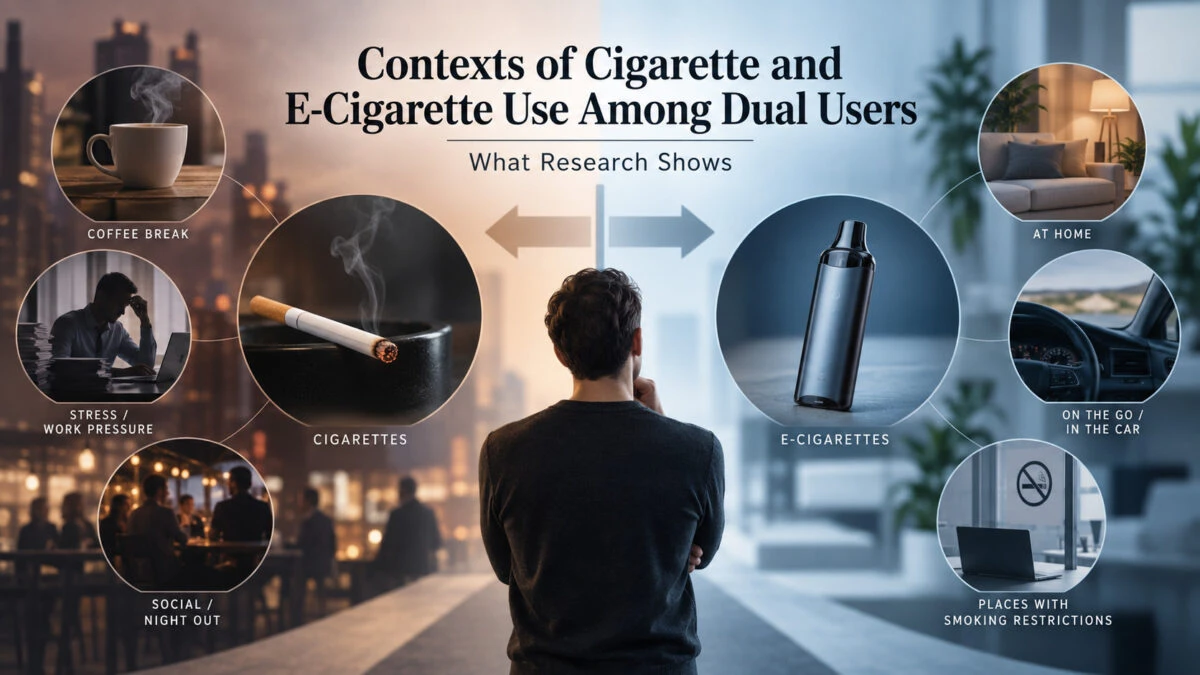
People who use both conventional cigarettes and e-cigarettes do not necessarily use the two products in the same situations. For some adults, cigarette smoking remains connected with established routines, cravings, stress, social situations, or alcohol, while e-cigarette use may occur in a different set of environments.
A qualitative study by Pokhrel and colleagues examined exactly this question: when and why do dual users choose cigarettes versus e-cigarettes? Published in BMC Public Health in 2015, the study used 12 focus-group discussions involving 62 young adult daily e-cigarette users, almost all of whom were current or recent cigarette/e-cigarette dual users.
This article explains the main findings and, importantly, their limitations. The study provides insight into behavioral patterns, but it should not be interpreted as proving that every dual user behaves in the same way.
Age & Nicotine Notice
This content is intended for adults of legal smoking or vaping age only.
Nicotine is addictive, and many e-cigarettes contain nicotine. E-cigarettes and other tobacco or nicotine products are not risk-free. Adults who have never smoked or used tobacco products should not start using them. Rules concerning the purchase, possession, use, import, and sale of vaping products vary by country and region, so always check current local regulations.
For product-specific age and purchasing information on VozolVapen, see the VozolVapen FAQ.
Key Takeaways
- Cigarette use in the study was frequently connected with strong cravings, stress, established routines, social situations, and the use of substances such as alcohol or coffee.
- Being around other cigarette smokers could act as a smoking cue for some participants.
- E-cigarette use was reported in settings such as work, home, vehicles, and situations where cigarette smoking was unavailable or restricted.
- Product availability mattered: some participants reported smoking cigarettes when their e-cigarette was unavailable.
- Dual use did not always represent a straightforward transition from cigarettes to e-cigarettes.
- Because this was a small qualitative study conducted in 2015, its findings should not be generalized to all current adult smokers or e-cigarette users.
Cigarette vs E-Cigarette Use Contexts at a Glance
| Context | Cigarette Use Reported in the Study | E-Cigarette Use Reported in the Study |
|---|---|---|
| Strong craving | Frequently mentioned | Some participants considered it less suitable in these moments |
| Stress | Commonly associated with cigarette use | Less prominent as a specific theme |
| Before or after meals | Reported cigarette cue | Less prominent |
| Coffee | Associated with cigarettes for some participants | Less prominent |
| Alcohol and parties | Frequently associated with cigarettes | Could also occur |
| Around cigarette smokers | Important cigarette cue | Sometimes less preferred |
| At work | Cigarette use could be less convenient | Commonly discussed context |
| At home | Both could occur | Frequently reported |
| Indoors | Cigarettes could be restricted | E-cigarette use commonly discussed |
| In a vehicle | Cigarette use could be less convenient | Reported by participants |
| Cigarettes unavailable | — | E-cigarette could serve as an alternative |
| E-cigarette unavailable | Cigarette could become an alternative | — |
The table summarizes themes identified in Pokhrel et al. (2015). These were qualitative observations from study participants and should not be treated as population-wide statistics.
What Is Cigarette and E-Cigarette Dual Use?
In general, dual use refers to using both conventional combustible cigarettes and e-cigarettes.
However, this broad definition can include very different patterns. One adult might smoke cigarettes every day and vape occasionally, while another might primarily use an e-cigarette but continue to smoke cigarettes in particular social situations.
The CDC also uses the term “dual use” when discussing people who both vape and smoke cigarettes. Public-health guidance emphasizes that simply adding e-cigarettes while continuing to smoke should not be considered a way to eliminate the health risks associated with cigarette smoking.
Understanding these differences is important because simply labeling someone a “dual user” tells us relatively little about when, where, and why each product is used.
What Did the Pokhrel Study Examine?
The study titled Contexts of Cigarette and E-Cigarette Use Among Dual Users: A Qualitative Study was published in BMC Public Health on September 4, 2015.
Researchers conducted:
- 12 focus-group discussions
- 62 participants
- Current daily e-cigarette users
- An average participant age of 25.1 years
- A sample that was 63% male
- A population made up almost entirely of current or recent cigarette/e-cigarette dual users
The purpose was not to determine how common each behavior was in the general population. Instead, the researchers wanted to identify recurring themes describing the circumstances in which participants chose one product rather than another.
You can read the original research through PubMed or the full BMC Public Health article.
What Contexts Were Associated With Cigarette Use?
The study identified several broad categories connected with cigarette smoking among participants.
These included:
- Specific daily activities
- Strong cravings
- Stress or a desire for stimulation
- Social settings
- Other cigarette smokers being present
- Alcohol or coffee consumption
- Situations where an e-cigarette was unavailable
These findings suggest that cigarette use among dual users may be strongly connected with previously learned routines and environmental cues.
Strong Cravings and Stress
Strong cravings were one of the situations participants associated with cigarette use.
Stress also appeared repeatedly in the discussions. Some participants described wanting a cigarette during stressful situations or at moments when they felt a stronger need for stimulation.
This should not be interpreted as evidence that cigarettes are an appropriate way to manage stress. Instead, the finding demonstrates how stress can become associated with established smoking behavior.
For habitual users, these associations may persist even when another nicotine product is available.
Daily Routines Can Become Smoking Cues
Cigarette smoking was also associated with ordinary daily activities.
Participants mentioned situations such as:
- Before or after eating
- After waking up
- Before going to sleep
- Following particular activities
- Established personal routines
These types of associations can be thought of as habitual cues.
For example, repeated cigarette use after a meal can eventually create a strong association between finishing food and wanting to smoke. Coffee can operate in a similar way for some people.
This helps explain why dual use is not simply a question of having access to two products. Existing behavioral routines may influence which product a person chooses in a particular situation.
Social Situations Can Influence Product Choice
The people around a dual user may also affect smoking behavior.
Being Around Other Cigarette Smokers
One of the clearest social themes in the study was the presence of other cigarette smokers.
Some participants reported being more likely to smoke when friends, partners, or other people nearby were smoking cigarettes. Seeing cigarettes or being around established smoking situations could therefore operate as a cue.
This illustrates an important feature of tobacco behavior: product choice can be influenced by social environment as well as individual preference.
Parties, Weekends, and Socializing
Cigarette use was also discussed in connection with:
- Parties
- Weekends
- Social gatherings
- Special occasions
- Spending time with friends
- Outdoor social situations
For some participants, cigarette smoking had a stronger social association than vaping.
However, that should be described as a participant perception, not as a universal characteristic of cigarettes or e-cigarettes.
Different adults may develop very different social patterns around nicotine use.
Alcohol and Coffee as Cigarette-Related Cues
The study also identified the use of other substances as a cigarette-smoking context.
Alcohol was especially prominent.
Some participants reported wanting or smoking cigarettes while drinking alcohol, and coffee or caffeine was also mentioned as a smoking-related cue.
These findings do not mean that drinking alcohol or coffee automatically causes someone to smoke.
Instead, repeated pairing of two behaviors may establish an association. Someone who has repeatedly smoked while drinking coffee, for example, may experience the coffee-drinking situation itself as a smoking cue.
When Were E-Cigarettes Used Instead?
The study identified a somewhat different pattern for e-cigarette use.
Participants described using e-cigarettes during particular activities and in specific locations, but two themes were especially important:
- Using an e-cigarette when a cigarette was unavailable.
- Using an e-cigarette where cigarette smoking was prohibited or inconvenient.
This suggests that at least some dual use may involve context-dependent switching rather than a complete replacement of one product by another.
E-Cigarette Use at Work
Work was one environment discussed in relation to e-cigarette use.
Some participants described vaping as more compatible with their work routine than leaving an area to smoke a cigarette.
However, workplace policies have changed substantially since the study was conducted, and regulations vary between jurisdictions and individual employers.
The fact that study participants reported vaping at work should therefore not be interpreted as meaning that vaping is currently permitted in workplaces.
Always follow current employer policies and local regulations.
E-Cigarette Use at Home and Indoors
Participants also discussed using e-cigarettes:
- At home
- Indoors
- While alone
- In vehicles
Some participants believed vaping was less disruptive than smoking in these situations.
Again, this represents participants’ perceptions at the time of the study rather than proof that indoor vaping is harmless.
Current public-health information notes that people nearby can also be exposed to e-cigarette aerosol. Indoor-use rules should therefore be based on current local policies rather than assumptions about exposure.
Smoking Restrictions Can Change Which Product Is Used
One particularly important finding was that some participants used e-cigarettes when cigarette smoking was prohibited.
This could create a pattern such as:
Smoking-permitted situation → cigarette
Smoking-restricted situation → e-cigarette
The significance of this finding is that dual use does not necessarily indicate that cigarette smoking is steadily disappearing.
For some participants, the e-cigarette functioned as an alternative during situations in which cigarettes were unavailable or smoking was inconvenient.
Device Availability Can Also Influence Dual Use
Availability worked in the opposite direction as well.
Researchers found that when an e-cigarette was unavailable, some participants returned to cigarettes.
Practical problems could therefore affect product choice in addition to cravings or social factors.
This is an important distinction because it suggests that dual-use behavior can depend on a combination of:
- Habit
- Environment
- Product availability
- Social setting
- Craving
- Established routines
Rather than treating vaping and cigarette smoking as completely separate behaviors, the study suggests they may interact with the same set of everyday cues.
Does Dual Use Mean Someone Is Trying to Quit Smoking?
Not necessarily.
One reason people sometimes assume that an adult uses both products is that the person is transitioning away from cigarettes. That may describe some users, but it does not describe everyone.
The researchers specifically distinguished between people potentially using e-cigarettes as cessation aids and people using them mainly as cigarette alternatives when smoking was unavailable or restricted. They concluded that more research was needed to understand the differences between these groups.
Current CDC information similarly notes that some adults use e-cigarettes in attempts to stop smoking, but no e-cigarette has been approved by the U.S. FDA as a smoking-cessation medication. CDC also advises that dual use should not be regarded as an effective way to protect health.
Anyone who wants help stopping cigarette smoking should consider discussing evidence-based cessation options with a qualified healthcare professional.
Why Context Matters When Studying Dual Users
The main lesson from this research is that product choice can be situational.
A dual user may not simply prefer cigarettes or prefer e-cigarettes across every situation.
Instead, behavior may follow patterns such as:
Stress → established cigarette cue
Meal → cigarette routine
Friends smoking → cigarette cue
Alcohol → cigarette-associated situation
Work or smoking restriction → e-cigarette
E-cigarette unavailable → cigarette
These are not rules that apply to every adult user. They are examples of patterns identified in the study.
The larger point is that cigarette and e-cigarette use can be shaped by psychological, behavioral, social, and environmental factors at the same time.
How Modern Vape Products Differ From Those Used in Earlier Research
The Pokhrel study was conducted more than a decade ago.
E-cigarette technology has changed substantially since then. Current products can vary widely in:
- Battery capacity
- E-liquid capacity
- Nicotine strength
- Nicotine formulation
- Coil resistance
- Mesh-coil design
- Rechargeability
- Charging port
- Airflow
- Puff-count claims
- Device displays
- Power modes
That technological evolution is another reason not to assume that behavior observed in 2015 perfectly describes adult vaping behavior today.
For legal-age adults who already use vaping products and want to understand current specifications rather than health outcomes, the VozolVapen online vape shop allows visitors to compare currently listed devices and product specifications.
Readers specifically researching the VOZOL range can also compare models in the VOZOL Vape product category.
Product specifications should always be checked on the individual product page, since battery capacity, e-liquid capacity, coil resistance, nicotine strength, airflow, charging features, and other parameters vary by model.
Important Limitations of the Study
Good research interpretation requires looking at what a study cannot tell us as well as what it can.
1. It Was a Qualitative Study
Focus groups are useful for discovering patterns and experiences, but they are not designed to estimate how common a behavior is in the entire population.
Therefore, statements such as “most dual users smoke after drinking alcohol” cannot be inferred from this research.
The study identified themes, not population prevalence.
2. The Sample Was Relatively Small
There were 62 participants.
That is appropriate for qualitative focus-group research, but it is not representative of all adults who smoke or vape.
3. Participants Were Young Adults
The mean age was approximately 25 years.
Patterns among older adults, occasional users, long-term smokers, or people in other cultural environments may differ substantially.
4. Participants Did Not All Have the Same Smoking History
The sample included both current and recent dual users.
Someone smoking cigarettes daily while occasionally vaping may behave differently from someone who primarily vapes but smokes cigarettes during certain social situations.
5. The Research Was Published in 2015
Device technology, nicotine products, vaping culture, smoking regulations, and public awareness have changed considerably since 2015.
The paper is therefore especially valuable for understanding behavioral context, but it should not be treated as a direct description of every dual user in 2026.
Common Misinterpretations to Avoid
When discussing cigarette and e-cigarette dual use, several conclusions should be avoided.
“Dual use means someone is quitting cigarettes.”
Not necessarily. Motivation varies between users.
“Using an e-cigarette somewhere means vaping is permitted there.”
No. Workplace, indoor-use, transportation, and public-space rules vary by jurisdiction.
“If someone vapes indoors, there is no exposure to other people.”
That conclusion is not supported. E-cigarette aerosol can be inhaled by nearby people.
“E-cigarettes are harmless.”
No nicotine or tobacco product should be described as risk-free.
“Every dual user experiences the same triggers.”
The Pokhrel study identified recurring themes in a specific qualitative sample; individual behavior can differ substantially.
What Should Adult Readers Take From This Research?
The study helps explain why understanding dual use requires looking beyond the devices themselves.
For some participants, cigarette smoking remained connected with cravings, stress, meals, coffee, alcohol, friends, and established routines.
E-cigarette use was more commonly discussed in contexts where cigarette smoking was unavailable, restricted, or inconvenient.
Device availability could then shift behavior in the opposite direction.
Taken together, these findings suggest that dual use may involve ongoing switching between products according to context rather than a simple linear movement from cigarettes to e-cigarettes.
That distinction matters for researchers, healthcare professionals, policymakers, and adults trying to better understand their own nicotine-use patterns.
Buyer and Information Checklist for Legal-Age Adult Vape Users
If you are already a legal-age adult vape user and are comparing devices, keep health questions separate from product-specification questions.
Before selecting a product, check:
- Your legal age and local vaping regulations
- Whether the product contains nicotine
- Nicotine strength shown on the label
- Battery capacity
- E-liquid capacity
- Coil type and coil resistance
- Rechargeable or non-rechargeable design
- Charging-port type
- Airflow options
- Manufacturer instructions
- Storage requirements
- Local rules concerning indoor or public use
- Import, shipping, customs, and disposal requirements
Never assume that a larger puff count, stronger nicotine concentration, or larger battery automatically makes a product more appropriate for you.
Legal-age customers can review currently listed products through the VozolVapen Shop. For questions about specifications, wholesale supply, stock, or shipping, use the VozolVapen Contact page.
FAQ
What is cigarette and e-cigarette dual use?
Dual use generally means using both conventional cigarettes and e-cigarettes. Frequency can vary considerably: one person may use both daily, while another may primarily use one product and use the other only in particular situations.
Why might dual users continue smoking cigarettes?
In the Pokhrel study, cigarette use was associated with factors including strong cravings, stress, habitual routines, being around other smokers, social situations, alcohol, coffee, and temporary unavailability of an e-cigarette. These findings describe themes from participants rather than universal causes.
When might a dual user choose an e-cigarette instead?
Participants discussed e-cigarette use in environments including work, home, vehicles, and situations where cigarette smoking was unavailable or restricted.
Local rules must still be followed because vaping is not necessarily allowed wherever cigarette smoking is prohibited.
Does vaping automatically replace cigarette smoking?
No.
The research showed that some users switched between products depending on circumstances. E-cigarette use therefore did not necessarily mean cigarette smoking had stopped.
Does dual use mean someone is trying to quit smoking?
Not always.
Some users may have cessation goals, while others may use an e-cigarette primarily as an alternative when cigarette smoking is impractical or restricted.
Are e-cigarettes safe?
They should not be described as safe or risk-free. Public-health authorities state that e-cigarettes can expose users to nicotine and other substances, and nicotine is addictive.
Is this 2015 study still relevant?
It remains useful for understanding how habits, environments, social cues, cravings, and product availability may influence dual-use behavior.
However, the age of the study is an important limitation because products, regulations, and patterns of e-cigarette use have changed.
Related Resources
For further research:
- Original study on PubMed: Contexts of Cigarette and E-Cigarette Use Among Dual Users
- Full BMC Public Health research article
- CDC: E-Cigarette Use Among Adults
- CDC: Dual Use of Tobacco Products
- CDC: About E-Cigarettes
For legal-age adults researching product specifications:
- Browse the VozolVapen Vape Shop
- Compare VOZOL Vape Products
- Read the VozolVapen FAQ
- Contact VozolVapen for Product or Wholesale Questions
Conclusion
The contexts of cigarette and e-cigarette use among dual users are more complex than simply preferring one product over another.
The Pokhrel et al. study found that cigarette smoking among participants could be linked to strong cravings, stress, meals, social situations, other smokers, alcohol, coffee, and the absence of an available e-cigarette. E-cigarette use, meanwhile, was commonly discussed in situations where cigarette smoking was unavailable, restricted, or inconvenient.
These findings support a broader understanding of dual use as a context-dependent behavioral pattern. They do not prove that every dual user follows the same pattern, nor do they establish e-cigarettes as safe or as a guaranteed smoking-cessation method.
Adults who use nicotine products should pay attention to their own behavioral cues, understand that nicotine is addictive, and follow applicable local laws. Legal-age adult customers who are researching device specifications can compare available products through VozolVapen and check individual product pages for nicotine strength, battery capacity, e-liquid capacity, coil configuration, airflow, charging features, and other specifications before making a purchasing decision.
Reference
Pokhrel P, Herzog TA, Muranaka N, Regmi S, Fagan P. Contexts of cigarette and e-cigarette use among dual users: a qualitative study. BMC Public Health. 2015;15:859. DOI: 10.1186/s12889-015-2198-z.

 English
  German
  Italian
  French
  Spanish
  Dutch
Dutch  Swedish
  Japanese
  Polish